
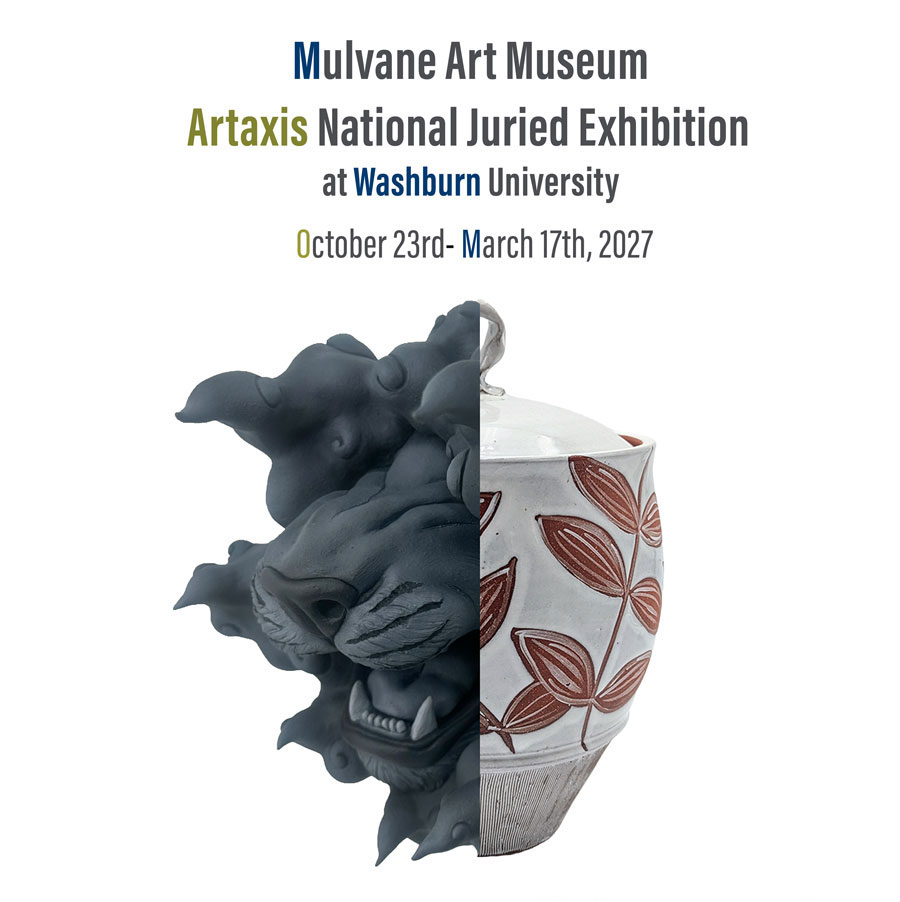
From October 23, 2026, through March 17, 2027, the Mulvane Art Museum at Washburn University hosts the 2026 Artaxis National Juried Exhibition, a ceramics exhibition featuring works by members of Artaxis and juried by Dr. Sara Stepp, Tyler Quintin, and Kyla Strid.
This exhibition is sponsored by Artaxis, Washburn University, the Glenda Taylor Memorial Fund, and the Mulvane Art Museum.
The 2026 Artaxis National opens on Tuesday, October 27. That same day, Artaxis members (and two of this year’s jurors) Tyler Quintin and Kyla Strid will lead a ceramics workshop in the Ceramics Studio at Washburn University in Topeka, Kansas.
Tyler and Kyla will demonstrate their very different approaches to contemporary ceramics and talk about the skills, techniques, and thinking behind their studio work. Learn more about the workshop HERE.
About Glenda Taylor
Professor Glenda Taylor joined the Washburn University art faculty in 1988 and taught there for nearly three decades, many of those years as Chair of the Art Department. She always put her students first, mentoring generations of ceramic artists while encouraging them to work across disciplines. A lifelong Kansan, Glenda made utilitarian vessels rooted in the Kansas landscape: open prairie and wheat fields, wildlife, wind and tornadoes, and fossils from the time when the state lay beneath an ancient sea. An avid cyclist, she was killed by a car while warming up for a race in 2015. The following year, NCECA posthumously named her a Fellow of the Council. The award is funded by the Glenda Taylor Memorial Art Department Fund, which continues to support the Washburn Art Department and its students.
About the exhibition jurors

Dr. Sara Stepp
Director, Mulvane Art Museum, Washburn University
Read bio
Dr. Sara Stepp is the Director of the Mulvane Art Museum at Washburn University (Topeka, KS), where she has worked since 2022. She earned a doctorate in art history with honors from the University of Kansas in 2023, and has taught university-level courses in art history and museum studies for nearly a decade. A few of her honors include an Andrew W. Mellon Diversity, Equity, and Inclusion Curriculum Fellowship and the Chu-tsing Li Award for Academic Excellence from the University of Kansas. Her work is driven by a passion for artistic inquiry, object-based learning, and interdisciplinary collaboration.

Tyler Quintin
Artist in Residence, Red Lodge Clay Center
Read bio
Tyler Quintin is an Artaxis member and a current long-term Artist in Residence at Red Lodge Clay Center (Red Lodge, MT). Prior to this, he completed residencies at the Arrowmont School of Arts and Crafts (Gatlinburg, TN), the Morean Center for Clay (St. Petersburg, FL) and the Haystack Mountain School of Craft (Deer Isle, MN). Tyler received a BFA from Washburn University in 2016 on a full tuition merit scholarship. Tyler was a 2024 Ceramics Monthly Emerging Artist. His work has been exhibited in numerous national and international exhibitions and is featured in the permanent collections of the Mulvane Art Museum (Topeka, KS), the San Angelo Museum of Art (San Angelo, TX), and the Arrowmont School of Arts and Crafts.

Kyla Strid
Potter and Program Officer, Mid-America Arts Alliance
Read bio
Kyla Strid (she/her) is a potter, teaching artist, Artaxis member, and arts administrator. Kyla’s work has been shaped by residencies around the world and by consulting on an archaeological dig of a Minoan pottery workshop in Crete. Drawing from ancient Minoan forms and botanical patterns inspired by her own backyard, she creates functional pots that invite daily use while carrying a sense of timeless beauty that is rooted in the here and now. When not in her studio, you can find her supporting fellow artists of all ages while serving as a Program Officer at Mid-America Arts Alliance.
The jurors selected 31 works for this exhibition by 29 artists: Sarah Alsaied, Natalia Arbelaez, Byron Ashley, Jeff Campana, Wei Cheng, Kristen Cliffel, Mya Cluff, Stephanie Dishno, Lalana Fedorschak, April Felipe, Steve Hilton, Yve Holtzclaw, Lauren Kalman, Clayton Keyes, Owen Laurion, Pauly Maloney, Peter Olson, Eric Ordway, Gina Pisto, Carlos Prado, Justin Rothshank, Jennifer Schumacher Waller, Hunter Stamps, Kirsten Taylor, Irén Tété, Brant Weiland, Taylor Wiens, Blake Williams, and Travis Winters.
Installation views
click on the images below for more information
Awards
My practice centers ceramics, architecture, and language as ways of thinking through memory, belonging, and transformation. I work with clay because it records pressure: touch, rupture, repair, and the slow accumulation of time. Through hand-building, surface testing, and modular construction, I create forms that move between the architectural and the bodily—thresholds, shelters, vessels, fragments, altars, and ruins.
My studio is a space of hope, belief, protest, softness, knowledge, and feeling. I write while I build, allowing language to move beside sculpture as a form of poetry - embodied, tactile, and spatial. Materials such as concrete, glass, wool, beeswax, and metal enter the work as companions to clay, carrying their own histories of labor, place, fragility, and endurance.
I am interested in forms that hold contradiction: permanence and disappearance, structure and collapse, weight and tenderness, control and release. Through repetition, layering, breaking, and repair, I make objects and installations that remain porous and unresolved - works that hold absence, resist closure, and stay searching.
My practice is attuned towards embodiment, the sketch and the unknown. Sculptural pieces reference kitchen labor and the pots and pans piling up by the “dish-pit” as metaphor for the messy and playful ways we navigate social space and relations. Through this work I have been revisiting my relationship to aspects of cultural anthropology attending to experiences and labor often excluded from normative cultural narratives. My approach follows a similar framework as ethnographic research albeit through personal and haptic lenses. Though there are glimpses of representation and moments of reference, identification and meaning becomes blurred by abstraction and a hyper toxic-looking chartreuse glaze.
With a conjunctive attitude, my studio practice is tuned towards destabilizing hierarchies while resisting taxonomies of knowledge. Relying on a more auto-ethnographic framework enables me to glean from my own encounters while creating a theoretical collage across sculpture, landscape, photography, pottery, phenomenology and the history of ceramics. Fabricating various ceramic objects along the theme of kitchen labor opens up concrete explorations referencing my own experiences in these complex social systems.
With my work I am constructing characters, often humorous, each focused on its own individual narrative. These stories are based on mundane day-to-day life, past struggles, and real people. Throughout our lives we encounter many “characters” and create our own stories. Some of these people and stories become part of our personal identity as we pass them on to those around us. I feel compelled to narrate these stories derived from human nature, universal experiences, and my own personal understanding of the world around me. Drawing from these observations, I am able to manifest prevalent themes about life within our contemporary society. By creating comical figures, I am initiating a non-threatening conversation about a variety of topics prevalent within our culture. Captivating the imagination of the viewer through open-ended stories, I invite the fabrication of personal narratives and encourage an intimate connection with the characters. This dialogue between viewer and figure encourages various interpretations, all while relating the narrative back to themes of everyday existence and experiences.
Influenced by my rural childhood picking dewberries and digging for clay, I focus on our relationship to land and the natural world within my artistic practice. I map the connections between humans, plants, animals, and place. I use foraged or local materials, when possible, to nurture my relationship with land. Responsibly foraged or cultivated plants become paper, ink, or natural dye. I use a regional clay and source local wood. I create mixed media sculptures depicting the animals and plants that I encounter within the ecosystems I call home. Through these sculptures, I explore the network of life that surrounds and sustains me, encouraging this exploration in the viewer as well. Inspired by the teachings of Indigenous and Black feminist thinkers, I resist the extraction and abstraction of Western knowledge systems. Through my art, I emphasize connection and relationship to promote healing. My intention is to inspire my audience to reconnect with the natural world.
Accepted works
My sculptural practice examines environmental legacy and institutional oppression through figurative forms that center human and animal subjects. I focus on marginalized and oppressed figures, using gesture, posture, and emotional tension to create narratives that are at once unsettling and alluring. These figures often embody complex emotional states—grief, resilience, tenderness—that invite the viewer into a space of confrontation and reflection. To extend the narrative impact of my work, I frequently photograph my sculptures in found or constructed environments. This process, akin to composing a two-dimensional image, removes the work from the traditional gallery setting and situates it within a world that better supports its emotional and thematic weight. These constructed contexts deepen the viewer's engagement, encouraging them to follow the narrative threads more intuitively and intimately. I aim to create experiences that are emotionally charged, visually compelling, and socially urgent—offering viewers space to feel, question, and respond.
As a geologist and a clay artist, I have developed an appreciation for the anomalies in the many forms of life, clay, rock, and soil covering the Earth. I am intrigued by the mathematics that describes the many different textures that makes up all things in nature.
The core of my work revolves around large-scale installations, often requiring the coordination and involvement of hundreds of individuals/artists to bring the artwork to fruition. In this context, the community fostered with the conversations and interactions with my collaborators are more important than the artwork.
Because of social and environmental concerns, I am committed to not firing any of my ephemeral installations.
My work explores the complexities of navigating personal and cultural histories in service to the construct of ones identity. Drawing from my experience as an American of Dominican and Puerto Rican descent, I explore these concepts through layered reliefs using the language of the home and body. I investigate how personal and cultural histories shape who we are and how we present ourselves.
I use the language of the domestic by incorporating rugs, embroidery, and ceramics because the home is an idealized place of “true” belonging. Ceramics, fragile yet enduring, serves as a material record, embodying both vulnerability and permanence. Framing the ceramic pieces is needle-punch embroidery, this slow, repetitive process reflects the cumulative nature of history, where each stitch is built upon the last. I refence the language of the body through hair, a marker of personal histories, and the ghost, who serves as observer, reminding us of what we hold on to by choice and what haunts us.
By layering materials and patterns, historical, found, and invented, I examine the constructed nature of the past, inviting reflection on the layered stories that shape identity and our enduring search for belonging.
My work explores moments of transition that lie in-between fixed states—those liminal places where meaning wavers and blurs and certainty dissolves. The moments that hold the fragile interval after things fall apart. The spaces of transition are places of pause, reflection and perception that reveal the feeling and sense of connection and separation.
The in-betweenness of things.
I use clay as a material to record the quiet moments and lived experience, moments of stillness, the space between and the connections that bridge them together. These records and relationships explore issues of uncertainty, loss, memory, grief and place of breath. Fibers and other materials are used to mend, connect or come between these moments and spaces. I am drawn to the presence of what once was there, the fragility of a moment and what we choose to hold onto and release.
In my work, I am a storyteller. I am telling narratives about my Colombian family’s immigration, the pre-Columbian South American presence, and my American latchkey, after school cartoon childhood. All of these stories work together to create a multicomponent self-portrait of what it is like to be a Mestizo Colombian-American hybrid. Mining tidbits from historical research, familial narratives, and cartoon culture, I create surreal stories in clay much in the way Gabriel García Márquez did with words, autobiographically narrating history with its ups and downs, its humor and tears.
Making my work is an act of revealing undervalued histories from Latin American, Amerindian and Women of Color. These identities are lost through conquest, migration, and time, then gained through family, culture and exploration, and finally passed down through tradition, preservation, and genetic memory. I have found value in my histories and aim to help preserve my cultures by honoring them through my artwork.
Peter Olson’s style goes against the grain of the organic process of shaping clay. His work incorporates a precision of image, line, and form that takes its inspiration from photography and design–both contemporary and classical.
He fires his printed imagery to meld it with the clay forms; without drips, blurred edges, or the expected organic hues of glazes. Olson’s new color work pieces are detailed with ornately hand-painted photos, in a process that harkens back his days of hand-coloring black and white photographs.
How is one transported through a memory? Within the process of remembering, we oscillate between past and present. The space between, through that rumination, creates variance and distortion within the memory itself. Our understanding of the past changes every time we recall it—there is an inherent destruction and fragmentation that occurs through remembering. I am curious about how one reconciles the space between past and present, life and death, permanence and impermanence. This mediation is a result of a search for meaning, an action that is meant to make sense of the past.
Through the construction of objects that reference still life paintings, flora, and domestic space, I examine the transformative and transportive potential of objects. It is through emotional capacity and imbued memory that ordinary things become extra-ordinary. I utilize quotidian forms and materials to construct ceramic works that function as portals—gateways to the past. Reminders of life, and death, are woven throughout the work within the sculpted flowers, bones, animals, insects, fruit, shells, and timepieces. The minimal color palette allows the work to transcend the mimetic and reach towards the metaphorical ways in which we access memory through objects. Upon viewing the work, one is at the precipice—the teetering edge between past and present. It is my hope that through further investigation of the work, the viewer passes through this metaphorical threshold to explore the past.
My body of artwork explores the deep-rooted traditions and emotional resonance of life on a three-generation family farm. By merging my expertise in graphic design, ceramics, printmaking, and glaze research, I have developed a unique method of printing on clay with underglazes, creating layered imagery that tells the heartfelt stories of my farm family. My inventive forms—tiles, architectural structures inspired by farm buildings, portraits, and figures—capture the often-overlooked yet essential aspects of rural life, portraying both the relentless challenges farmers face and the profound sense of belonging and tradition they embody.
Earth-toned clay represents the soil, with rigid, abstracted forms pieced together into a mosaic of memories. Dominant colors like yellow and green reflect the hues of my childhood and the enduring elements of farm life. Yellow evokes fields of winter wheat, piles of corn and soybeans, and the optimism of my family, while green signifies growth, vitality, and the iconic John Deere equipment. Small mixed-media elements, including wire and worn farm objects, add texture and context, enriching the narrative.
Through my art, I seek to honor and preserve the legacy of my family and farming communities across the Midwest, celebrating the resilience, connections, and traditions that define agricultural life. My work invites viewers to experience the meaningful stories and emotions rooted in the family farm.
I make performative objects that use my body as a tool for production and as an installation site. Through these objects my work investigates constructions of the ideal and the feminine as they relate to self-image, identity, and the built environment. My work bridges fine art, craft, and design. I use a variety of methods in my work including fabricated metal, textiles, glass, and ceramics folded together with installation, performance, photography, and video. My work often uses vernacular domestic or craft media. I work with these familiar materials and forms as a strategic choice, because of their tie to the body through their use in jewelry, domestic objects, cutlery, functional vessels, hygiene implements, and clothing.
"To Have or To Hold..." and “Until...” are comprised of performance videos and vessels. I produce wheel thrown ceramic vessels that I distort through holding against my body and each other. The carefully controlled form of the vessel is lost with the imprint of the body leaving both a permanent distortion of the original form and the lasting imprint of the absent body. Once the vessels are formed, they are not altered, cracks, folds, and textures are all fired in place.
This work is the first of a series of large-scale vessels cast from black-stained porcelain and diamond-polished to a glass-like sheen. It is an exploration into what is possible in ceramics if we leave behind the need for the hand, and use computer tools, capable of incredible complexity and precision. The object is one of a kind, cast from a modular library of interchangeable mold parts.
I make finely crafted still lifes that reenact the ordinary — consumer goods, cardboard boxes, junk food, a PlayStation controller, rendered in porcelain. My work speaks to the fleeting nature of desire, consumption, and the ambivalent pleasures of capitalism. My objects operate as tableaux and catalogs: witnesses to celebrations already past. The narrative itself reveals fears, joy, insecurities, and the small rituals that stitch ordinary life together. I often use humor as a tool to approach weightier themes so the work can be both affectionate and critical. I am interested in the tension between admiration and permanence: the act of choosing, consuming, and appreciating a moment that is fleeting but here made permanent in ceramic and glaze. My creative process requires careful considerations, printing saturated commercial colors juxtaposed against pale glaze washes. By recreating familiar objects with care and slight distortion, I invite viewers to recognize their own complicity, nostalgia, and longing, and to consider how value is assigned, lived, and remembered.
My pottery derives its forms from historical Scandinavian folk arts and the story of a 150-year-old family farm. Born into a family of Norwegian farmers who immigrated to the United States in 1856, I carry on the tradition of my great-grandparents’ handmade craft objects by researching Norwegian ale bowls. In probing Viking-era burial sites like the Oseberg Mound, I rediscovered my ancestry separately from family stories steeped in dogma. By sculpting finials of mythological creatures, I touch upon how ancestral homelands are both myth and reality for American descendants of immigrants. Just as I grew up with Viking lore, I counter the myths in my upbringing by embracing my forebears as farmers. As my hands feel, pinch, turn, lift, and heft the soft clay, I contemplate my ancestors toiling with their hands in the earth, in wood, and in stone. My forms echo the rich practice of working the land, manifesting as soft-formed clay walls reminiscent of rolling hills. Vertical carved ridges, akin to plow-scraped fields, meet with gentle wave-like rims. Working with a kick wheel, I capture the rhythmic movement juxtaposed by sharp vertical textures. With this artistic labor, I take part in my family’s legacy of hard work and storytelling, uniting the farmer and the academic at a common table.
Making ceramic sculpture helps me examine the emotional architecture of domestic life: the stories, expectations, comforts, contradictions, and quiet labor that shape our ideas of home. Through layered visual narratives using hand-built forms, decorative surfaces, symbolic objects, I explore how love, family, caregiving, and identity are constructed, performed, questioned, and sustained over time.
Humor and beauty are tools for entering deeper, more complicated emotional spaces. I’m interested in the tension between devotion and exhaustion, fantasy and reality, tenderness and constraint.
Clay is central to this investigation because it is intimate, responsive, and physical. It records touch. It requires patience, attention, and care. The processes of forming, drying, firing, glazing, mirror the deliberate work of building a home and maintaining relationships. I value the way ceramic objects can feel both fragile and enduring, decorative and powerful, personal and universal.
My practice is rooted in personal experience, but not limited to autobiography. I’m using the domestic stage to investigate broad cultural narratives: how we define success, how care is valued, how identity shifts within roles we inherit or choose.
Motherhood is multifaceted. My work takes back the narrative of the mother from centuries of idealization and outsider perspectives to redirect toward nuance through the semi-autobiographical lens that I offer. I lead a thread of questioning in my work to explore boundaries, and blurred relationships between mother and child, and mother and self. I dive into the life and death cycle inherent in creation. I am inspired by maternal psychology and lineage, but I am struck most by every individual and varied story of motherhood I come across, how they all contain the common thread of exploration, renewal and loss.
In my art practice, I approach the animal as a proxy, expressing psychological states that are socially suppressed but physically felt. I focus on white rabbits because of their interdependence with humans: in the wild, white rabbits are evolutionarily disadvantaged because of their inability to camouflage, but this same trait makes them easier to manage in farming environments, where they are bred for fur, meat, and laboratory use. White rabbits are culturally encoded as symbols of luck, curiosity, and transformation, often marking a path into subterranean networks of awareness. Personally, I have been chasing rabbits for years, fascinated by the human-animal interface, and seeing their gestures as mirrors that reflect deeper truths. By diffusing human psychic states through animal figures, I create a disarming and unsettling distance that invites viewers to laugh, flinch, and see themselves reflected in the work.
Williams’ Making Mends series addresses the healing power of making after experiencing profound loss. Pieces are created by sewing hundreds of hand formed porcelain finger bones onto vintage tatted textiles, celebrating the power of historical and contemporary slow craft. The unknown histories of handmade textiles are approached as maps for Williams to layer her own handmade finger bones, where both the permanent and impermanent, the known and unknown, and the private and public join together. Objects that carry silent memories which are left behind and the fragility of life are woven and revealed. The action of making reaffirms the present as it honors the past.
In life we will all suffer loss, and our grief can turns us inward toward the past in a way that isolates us. However, loss can be filled with memory, which shapes identity, personal understanding, and growth. The work within Making Mends reaches out to connect and comfort through a sense of shared experience, leading us toward a deeper understanding of ourselves and what it means to be human.
This body of work investigates how the mind collects and organizes fragmented images from memory in order to continuously recreate a sense of history and self. The work manipulates, abstracts, and conceptualizes the body’s material and psychological reality. The intent of my work is to seduce and engage the viewer with temporal surfaces and organic formal abstractions that trigger meditation on the mutability of the mind and body.
Psychological phobias, obsessions, aberrations, and anxieties are communicated through the tension and gesture of my formal language. Certain images and surfaces resonate in my mind and are synthesized into abstract visualizations for my sculptures. These visual references include cropped figurative photographs, scientific medical displays and other images of contortion, deformity and fluidity. This process of organic abstraction uses a vocabulary of reference to the body’s physicality without any literal details.
The physicality of my ceramic process exploits the malleability of clay and its tendency to convey the elasticity and muscularity of the body. The forms themselves are often thrown on the wheel, altered and then assembled to achieve the desired changing repetition of form. Surface treatments range from specially formulated low-fire glazes to atmospheric firings to mixed-media rubber, encaustic and resin applications.
My artwork is a collection of narratives, each piece capturing the vulnerability within the raw, messy, and imperfect nature of the intimate idiosyncrasies that define our private moments. In an era marked by growing disconnection, my curiosity centers on the potential for building empathy through shared lived experiences and the common threads that tie our individual stories together.
While some of my art represents the more impactful experiences in life, much of my work explores the quieter yet equally influential moments that contribute to constructing our greater sense of self. Individually, each piece reads as a snapshot in time, much like a chapter in a book. Together, the figures and vessels create a story reflecting my exploration of sexuality, gender, identity, and the fundamental human need for intimacy and desire.
My work is rooted in drawing. My sketchbook is filled with comics that channel my experiences into stories to help make sense of my world. These works are derived from those drawings, dealing with self doubt, fear, loss, and fault. Often questioning how to best care for myself and the people I love, I consider the blurry nature of codependence, stewardship, and caretaking my work.
My process is spontaneous, meticulous and unfussy. I abstract, anthropomorphize, and exaggerate my subjects to express their metaphysical characteristics. My work, speckled with the things that I have loved and lost, tells open-ended stories, about magic, love, and nostalgia. These tales gather like leaves caught on a fence. When they twist and spin, I see how the wind moves among them.
My practice explores how ceramics can shape our perception of place and how objects carry meaning across time, geography, and migration. Shaped by the experience of living across two countries, I am interested in how cultural memory is preserved, altered, and rebuilt through material.
My Taihu Dream series begins with Taihu stones, naturally formed rocks long collected and admired as miniature landscapes. Rather than reproducing them, I use clay to construct imagined terrains in which porous, stone-like forms merge with found objects, antique fragments, and personal souvenirs.
I am drawn to objects that have outlived their original purpose. Some are preserved because of cultural or historical value, while others survive through personal attachment, accident, or care. When brought together, these fragments create new relationships between places and histories that may never otherwise meet.
In my work, clay becomes both landscape and archive. It holds traces of movement, memory, and human attention, while allowing inherited forms to be transformed rather than simply repeated. Through these sculptures, I consider preservation as an active process of carrying, reinterpreting, and deciding what remains.
My work investigates how inherited cultural forms persist, transform, and acquire new meanings through experiences of migration and displacement. I draw upon the visual language of classical statuary, which symbols that have traveled across centuries and continents, to examine the ways cultural traditions shape identity while remaining open to reinterpretation.
Working primarily in clay, a material deeply tied to memory and continuity, I recycle and reconfigure familiar figures from art history. Through fragmentation, repetition, and physical intervention, these forms become sites where personal and collective histories intersect. I am interested in the tension between preservation and change: how cultural narratives endure even as they are reshaped by movement, loss, adaptation, and resilience.
I am a vessel maker. The vessel is my structure, my canvas – an empty page waiting to be filled. A field recorder of sorts, I attempt to synthesize my daily experiences through written word on anthropomorphized forms. These stories range from the mundane to the unworldly, from punk rock dive bars to a 10th century castle – anything and everything that has a story I feel the need and duty to share this with future humans.
I dress my pieces like sauce on BBQ. The sauce sets the backdrop for the staged piece. After this the free-verse begins. Do I address daily fears of how to maneuver an international pandemic? Or discuss my father’s 10 year battle with Alzheimer’s? What about that time the sandwich at the bodega made me hurl? What about presenting openly as They/Them for the first time in my 30's? The decisions of how to capture the essence of occurrences and emotions begin to flow naturally with a freestyle-like response, both formally and written. Each individual piece becomes a memento of the daily grind – recorded with no filter. All cloud.
Whether I work intimately with a sculpture, transition to a larger coil vessel or throw 100 plates, the ending tends to be the same. Momentary reflections conveyed through ceramic that gives a snippet of humanness, both told and implied.
I'm interested in social justice and the natural environment. I create functional pottery with layered visual and narrative surfaces, reflecting the complexity of these issues. I gather inspiration from the natural environment where I live, and the world around me.
I also make pottery depicting political leaders from our collective history, and floral imagery including the poppy flower, that represent remembrance and honor for those who have served, my opposition to war, and my interest in working towards positive social change thru relationship building.
In making this work, I've reflected on the beauty, inspiration and energy that the environment provides to me...the wildlife, changing seasons, flora and fauna, fuel and resource. Yet I recognize that we've changed the natural environment significantly since our arrival on this land. I make this work as a reminder of the responsibility I carry in preserving the natural environment, educating those around me, and understanding the history that impacts the present and the future.
As a Brown woman, my work exists in the space between Eastern and Western sensibilities and cultures, the works often explores themes of identity, power, and labor.
The uncanny, a fertile ground for the strange and the other. My works find their place at the radical intersection of the real and the strange, the seen and unseen. My sculptures often take on bold, theatrical, and haunting forms. They resemble deities, seers, or warriors. figures exist beyond physical, societal, and cultural constructs and limits.
Adornment plays a key role in my work, acting as both a shield and a statement. I am inspired by SWANA cultural practices and expression, and Western expression. I work intuitively, using recycled materials and fibers, I tear, harden and layer —to create forms that feel both delicate and strong, transforming the sculptures into characters that hold both anonymity and expression. Layers of texture and form turn my figures into vessels of memory, carrying personal and collective stories and experiences.
At its core, my work celebrates the feminine as a force of power, existing in both the intimate and the monumental. I aim to reverse the gaze, challenge the narrative and honor privacy.
My work explores moments of transition that lie in-between fixed states—those liminal places where meaning wavers and blurs and certainty dissolves. The moments that hold the fragile interval after things fall apart. The spaces of transition are places of pause, reflection and perception that reveal the feeling and sense of connection and separation.
The in-betweenness of things.
I use clay as a material to record the quiet moments and lived experience, moments of stillness, the space between and the connections that bridge them together. These records and relationships explore issues of uncertainty, loss, memory, grief and place of breath. Fibers and other materials are used to mend, connect or come between these moments and spaces. I am drawn to the presence of what once was there, the fragility of a moment and what we choose to hold onto and release.
My body of artwork explores the deep-rooted traditions and emotional resonance of life on a three-generation family farm. By merging my expertise in graphic design, ceramics, printmaking, and glaze research, I have developed a unique method of printing on clay with underglazes, creating layered imagery that tells the heartfelt stories of my farm family. My inventive forms—tiles, architectural structures inspired by farm buildings, portraits, and figures—capture the often-overlooked yet essential aspects of rural life, portraying both the relentless challenges farmers face and the profound sense of belonging and tradition they embody.
Earth-toned clay represents the soil, with rigid, abstracted forms pieced together into a mosaic of memories. Dominant colors like yellow and green reflect the hues of my childhood and the enduring elements of farm life. Yellow evokes fields of winter wheat, piles of corn and soybeans, and the optimism of my family, while green signifies growth, vitality, and the iconic John Deere equipment. Small mixed-media elements, including wire and worn farm objects, add texture and context, enriching the narrative.
Through my art, I seek to honor and preserve the legacy of my family and farming communities across the Midwest, celebrating the resilience, connections, and traditions that define agricultural life. My work invites viewers to experience the meaningful stories and emotions rooted in the family farm.
My work investigates how artifacts tell a story of self and place through the recreation of objects. I utilize wheel throwing and mold making primarily for its ability to borrow from the world. Working with porcelain makes use of the material’s ability to emit luminosity while obscuring it's source, reproducing impressions from slip morphs them into ghostly echoes. Translating items into clay allows for a close examination of the components and preserves them by way of the material’s archival nature. At times the forms are found by happenstance, others are drawn from memories and conversations. I seek to understand how context and proximity play a role between perception and imagination as I consider historical references while acknowledging the layers of chance and lived experience.
 2026 Artaxis National